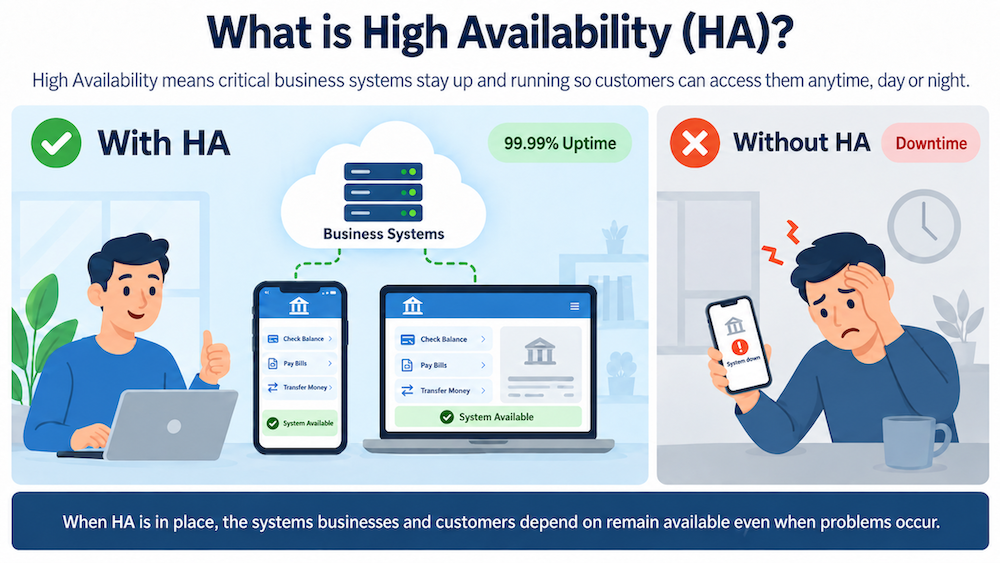
AI is changing how companies serve customers, analyze information, and get work done. The opportunity is real, and organizations are right to explore it. But as AI projects draw attention and resources, high availability and disaster recovery cannot become yesterday’s priorities.
Customers still expect applications to work when they need them. Employees still need access to the systems that run daily operations. When those systems go down, even briefly, work stops and confidence can suffer. Adding AI to a business does not reduce its dependence on reliable infrastructure. In many cases, it adds new dependencies to protect.
Past Outages Offer an Important Reminder
Past outages make that clear. In one well-documented incident, a failure in storage infrastructure used by Cloudflare’s Workers KV service disrupted several Cloudflare products for over two hours. The affected services included access and security tools as well as Workers AI. One underlying dependency had consequences across a wide range of services.
Similarly, a major AWS service disruption in its Northern Virginia region began with a DynamoDB DNS issue and went on to affect other services, including EC2 instance launches and some network load balancers. The disruption illustrated how problems can spread through the services an application relies on, even when its own servers remain healthy.
These incidents reinforce the importance of understanding application dependencies and preparing for failures across them. A recovery environment that relies on the same unavailable service may leave the business facing the same problem.
Keep Availability in the Conversation
As organizations plan AI investments, they should also revisit a few practical questions:
- Which applications are essential? Identify the systems that support customers, employees, and daily operations.
- How much downtime can the business tolerate? Set clear recovery goals based on business impact.
- What does each application depend on? Include databases, storage, networking, authentication, and external services.
- Have failover and recovery procedures been tested? Confirm that applications can return to service within the time the business needs.
Those questions apply to established applications and new AI workloads alike. High availability helps keep applications running through certain failures, while disaster recovery prepares organizations to restore operations after more extensive disruptions. Both require ongoing attention as environments change.
Build Innovation on Reliable Systems
An AI initiative may promise faster decisions or better customer experiences, but those benefits depend on the availability of the systems behind it. Protecting uptime deserves a place in the same planning and budget conversations as innovation.
Companies can move forward with AI while continuing to invest in resilience. Keeping high availability and disaster recovery a priority helps ensure that both new capabilities and everyday business operations remain dependable.
Author: Ben Roy, Marketing Program Manager at SIOS