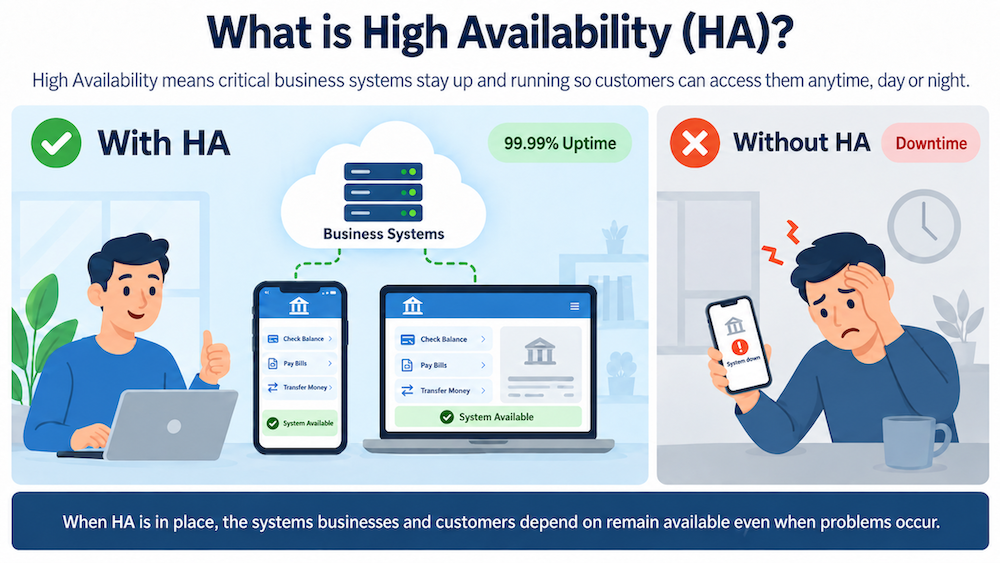
While the tech world races toward the cloud, nearly half of North American businesses still depend on on-premise data centers to power their most critical operations.
If your organization is among them, you already understand the pressure: downtime isn’t an option. In today’s always-on digital economy, high availability (HA) isn’t just an IT goal — it’s the foundation of business continuity, customer satisfaction, and long-term profitability.
Let’s look at three key ways to strengthen your uptime — and how SIOS can help you future-proof your operations.
High Availability Starts with a Resilient Physical Environment
Before software and servers come into play, your data center needs a strong physical backbone.
High availability starts with:
- Reliable power: Generators and UPS systems to keep you online throughout outages.
- Access security: Cameras and badge controls to prevent unauthorized entry.
- Environmental monitoring: Smart sensors to maintain ideal temperature and humidity.
- Fire protection: Modern suppression systems that protect equipment without damage.
Your infrastructure is only as resilient as the environment that houses it.
High Availability by Design: Redundancy That Keeps You Online
Even with a secure facility, no hardware or system is fail-proof. That’s why smart architecture is all about redundancy — ensuring no single point of failure can take you down.
Best practices include:
- HA clustering for critical applications.
- Redundant networking to keep data flowing if one path fails.
- Storage replication and RAID to prevent data loss.
- Offsite disaster recovery to ensure fast restoration after a major outage.
Designing for resilience means your users stay connected, even when systems don’t cooperate.
Achieve Continuous Uptime with Intelligent Monitoring and HA Clustering
With your environment and architecture in place, you need visibility and automation to keep everything running smoothly. Comprehensive monitoring and automated failover tools are what transform redundancy into true high availability.
- IT operations management tools that excel at discovering network assets and updating your configuration management database (CMDB).
- Application Performance Monitoring (APM) tools that give a precise understanding of the health of the systems comprising the network.
- HA Clustering Software such as SIOS LifeKeeper
The SIOS Advantage: Flexible, SANless High Availability and Disaster Recovery for Any Environment
SIOS delivers full high availability and disaster recovery for your most critical applications — without the need for shared storage.
Here’s what makes it stand out:
- Flexibility: Works in any environment — physical, virtual, cloud (AWS, Azure, Google Cloud), or hybrid.
- Lower costs: No need for costly SAN hardware or specialized expertise.
- Scalability: Easily cluster across multiple data centers or cloud availability zones.
With SIOS, you can build a SANless high availability solution that’s powerful, cost-effective, and easy to manage — perfect for any IT environment.
Request a demo today to see how SIOS can help you achieve reliable, cost-effective high availability and disaster recovery.
Author: Trey Isaac, Sr. Product Support Engineer at SIOS