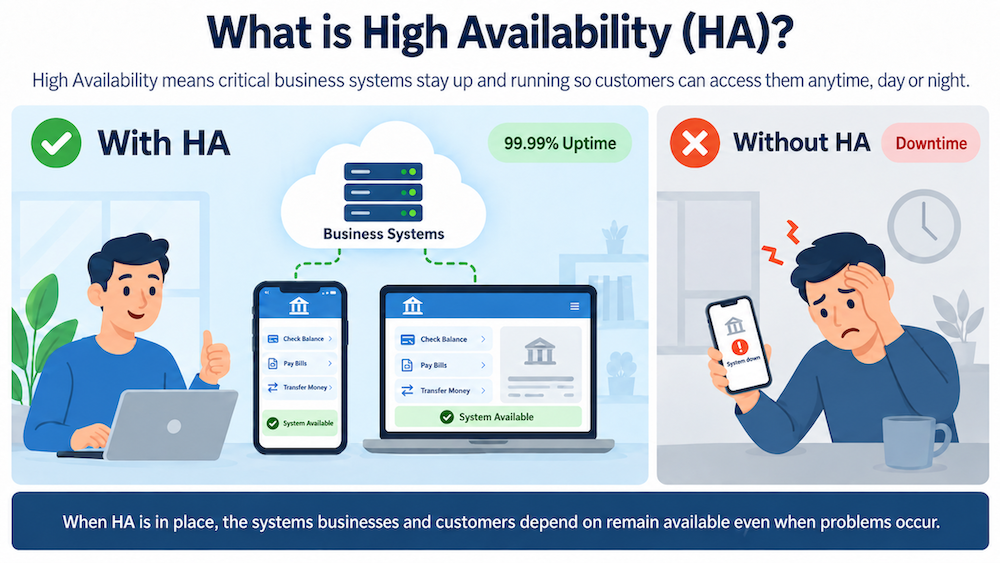
When people think about high availability (HA), the first thought is technologies such as clustering, automated failover, replication, and disaster recovery. These capabilities are fundamental to keeping applications and services available. A potentially overlooked aspect of an HA solution is how administrators interact with and manage the environment.
Today, many solutions offer both a graphical user interface (GUI) and a command-line interface (CLI). Each serves a valuable purpose, and the best choice often depends on the task at hand, the size of the environment, and an organization’s operational practices.
While GUIs provide an intuitive way to visualize cluster health and perform administrative tasks, a CLI offers a different set of strengths that can be particularly useful in highly available environments. Understanding these benefits can help organizations determine how a command-line interface fits into their overall management strategy.
Supporting Automation and Repeatability
One of the most commonly recognized advantages of a CLI is its ability to integrate with automation tools and scripts. Administrative tasks such as checking cluster status, modifying configurations, or performing routine maintenance can often be incorporated into shell scripts, orchestration platforms, or configuration management tools. This allows organizations to automate repetitive processes, which promotes consistency across environments and minimizes opportunities for manual error. As infrastructure grows, the ability to automate routine operations often becomes increasingly valuable to simplify maintenance tasks.
Scaling with Growing Environments
The management requirements for a single cluster differ from those of dozens or even hundreds of clusters. As environments expand, administrators often look for ways to perform common tasks efficiently across multiple systems. A CLI can make it easier to script repetitive operations, collect health information, generate reports, or perform coordinated maintenance across large environments. Rather than replacing graphical management, command-line tools can complement it by providing an efficient interface for large-scale administrative operations.
Encouraging Consistent Operations
Consistency is an important consideration in any production environment, particularly one designed for high availability. A CLI allows administrators to execute the same commands across development and production environments. Standardized procedures can be documented, reviewed, and reused, helping teams perform common administrative tasks in a consistent manner. This consistency helps reduce configuration drift over time and makes operational processes easier to reproduce during maintenance windows.
Flexibility for Remote Administration
Highly available environments are frequently distributed across multiple data centers, cloud regions, or geographic locations. Administrators may need to manage clusters remotely, sometimes under less-than-ideal network conditions. A CLI can provide a lightweight method for interacting with a cluster through secure connections. This can be particularly useful when bandwidth is limited or when graphical management tools are unavailable. While a GUI often provides a richer visual experience, a CLI offers an alternative management option that can remain effective in a wide variety of operational scenarios. Learn more about choosing a cloud for high availability.
Choosing the Right Interface
For many organizations, the question of choosing between a GUI and a CLI is not whether to use one or the other; it is how to use each effectively. GUIs excel at presenting cluster health, visualizing resource relationships, and making administrative functions accessible to a broad range of users. On the other hand, CLIs are often well-suited for automation, scripting, repeatable operations, and managing larger environments. Using both interfaces together allows administrators to take advantage of the strengths each offers while selecting the most appropriate tool for a given task.
Conclusion
Managing a highly available environment involves more than maintaining uptime; it also requires tools that support efficient, consistent, and reliable operations during maintenance or incident response. A command-line interface can offer advantages in areas such as automation, repeatability, and consistency. At the same time, graphical interfaces continue to play an important role by simplifying visualization and day-to-day management.
Rather than viewing one interface as a replacement for the other, organizations may benefit from understanding how each contributes to effective cluster management. By leveraging both where they make the most sense, administrators can build operational workflows that scale alongside their highly available infrastructure.
Author: Tristan Allen, Associate Software Engineer at SIOS Technology Corp