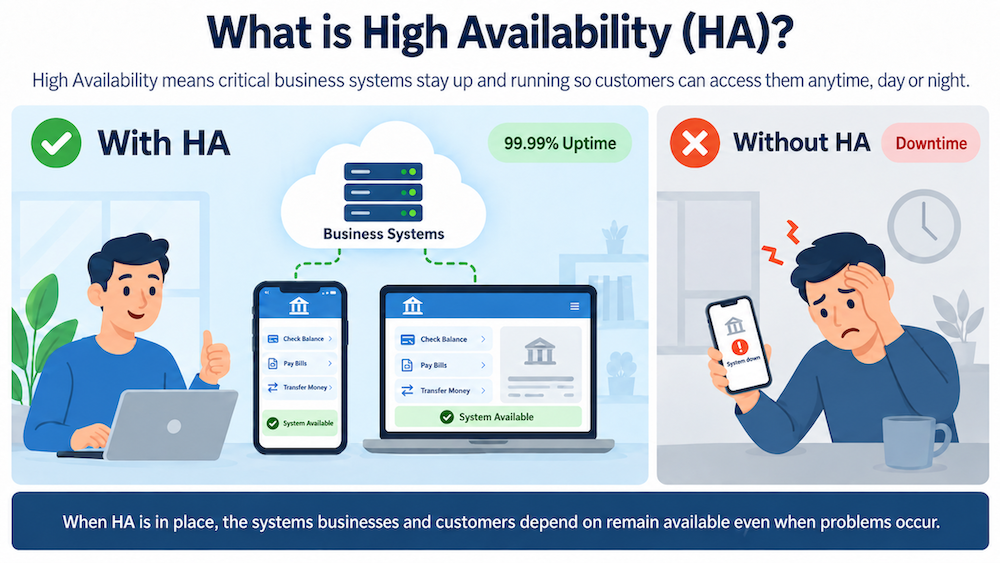
High Availability vs. Fault Tolerance is a common comparison when evaluating system designs that can be used together to create an infrastructure that is always on and functioning. The goal of High Availability is to ensure minimal downtime, whereas the goal for fault tolerance is to allow an infrastructure to remain running even when a failure occurs.
What Is High Availability?
High Availability serves as a way to ensure minimal downtime by guaranteeing that systems will be operational for at least 99% of the time. This is achieved through continuous monitoring of the health of an infrastructure.
High Availability can be three (99.9%), four (99.99%), or five (99.999%) nines. Each of the nines represents an expected uptime of an infrastructure. The standard is 99.99%, where the expected downtime per year is 52.60 minutes.
Software like SIOS LifeKeeper and DataKeeper provides 99.99% High Availability through monitoring and preventing long downtimes by automating failovers and replicating data.
What Is Fault Tolerance?
The purpose of Fault Tolerance is to eliminate a single point of failure to ensure that an infrastructure keeps running in the event of failure. This ensures the prevention of downtime and data loss.
Fault Tolerance can be achieved through error detection, load balancing, and/or microservices. For example, in the event of high traffic entering the network, load balancing is in place to reroute traffic to other servers, preventing failures caused by a heavy load.
High Availability vs. Fault Tolerance Cost Comparison
In a High Availability vs. Fault Tolerance comparison, fault-tolerant infrastructure typically costs more than a high-availability infrastructure due to the increased amount of software and hardware used. Maintaining an infrastructure that is continuously running and experiencing almost negligible downtime will require more hardware and software redundancy.
High Availability Use Cases
High Availability in Financial Services
Banks aim to maintain high availability to allow continuous processing of financial transactions. To do so, the typical environment requires databases and a configuration where a failover is possible in the event of a failure.
High Availability for Streaming Services
Streaming services, especially live, aim to provide continuous audio and/or video content to maintain their users. This, in turn, provides a seamless experience for users, allowing them to continue to use and operate the product.
Fault Tolerance Use Cases
Fault Tolerance in Healthcare
Many critical devices used in hospitals, life-support systems, ventilators, dialysis machines, etc, are always running 24/7. This is to ensure that patients are provided with uninterrupted life-saving care.
Fault Tolerance for Websites
Websites, like e-commerce platforms, that incur high amounts of traffic will host different parts of the sites on multiple servers. In the event of a failure on one server, the site will still be running and accessible.
Conclusion: High Availability vs. Fault Tolerance
While looking at High Availability vs. Fault Tolerance, it is clear that the two serve different purposes. Fault tolerance aims to have uninterrupted time in the event of a failure. At the same time, High Availability aims to ensure minimal downtime through quick recovery.
As organizations evaluate high availability vs. fault tolerance, SIOS helps simplify the path to stronger uptime and faster recovery. Request a demo to learn more.
Author: Alexus Gore, Customer Experience Software Engineer at SIOS Technology Corp.